



When Someone Searches for Help, Will They Find You?
Addiction recovery seo strategy is the process of optimizing your treatment center’s website to rank higher in search results, attract high-intent visitors, and convert them into admissions. Here’s what an effective strategy covers:
- Keyword research – Target high-intent, location-specific, and insurance-based search terms
- On-page optimization – Structure pages with E-E-A-T signals, clinical authority, and clear CTAs
- Local SEO – Dominate Google Maps and local search with an optimized Business Profile
- Technical SEO – Ensure fast load times, mobile responsiveness, and clean site architecture
- Content strategy – Build topical authority with educational, empathetic, patient-focused content
- Link building – Earn backlinks from healthcare directories, associations, and relevant publications
- Review management – Collect and respond to patient reviews to build trust and local rankings
Over 93% of online experiences start with a search engine. When someone is in crisis — or a parent is desperately searching for help for their child — the centers that show up at the top of those results get the call. The ones that don’t, don’t.
The challenge? Addiction treatment is one of the most competitive and heavily regulated spaces in digital marketing. Google’s ad restrictions on addiction services mean that organic search isn’t just a nice-to-have — it’s often your primary patient acquisition channel.
Most rehab centers either skip SEO entirely, hand it off to a generalist agency that doesn’t understand the space, or chase tactics that worked five years ago. The result is a leaky admissions pipeline and a census that never quite hits its target.
I’m Michael Krowne, CEO and Co-Founder of Faebl Studios — I’ve spent 20+ years in marketing and have helped rehab facilities across the country generate over 10,000 treatment admissions by building the kind of addiction recovery seo strategy that actually fills beds. In this guide, I’ll walk you through exactly how to do it.
Why a Specialized Addiction Recovery SEO Strategy is Non-Negotiable
If you’ve ever tried to run Google Ads for a rehab center, you know it’s like navigating a minefield while wearing a blindfold. Between the Healthcare and medicines policy and the mandatory LegitScript certification, the barriers to entry for paid search are massive. Even if you get certified, the cost-per-click (CPC) in the addiction space is among the highest in any industry.
This is Why SEO is Crucial for Drug Rehab Centers. Organic search provides a level of credibility that paid ads simply cannot buy. When a family is looking for help, they often skip past the “Sponsored” tags. In fact, roughly 71% of users ignore paid advertisements, focusing their attention on the top five organic results.
Furthermore, Google classifies addiction treatment under its YMYL standards (Your Money or Your Life). Because your content can directly impact a person’s health and safety, Google holds your website to a much higher standard of accuracy and authority than a local pizza shop. If your addiction recovery seo strategy doesn’t account for these stringent requirements, you won’t just rank poorly—you might not rank at all.
| Feature | Search Engine Optimization (SEO) | Pay-Per-Click (PPC) |
|---|---|---|
| Long-term ROI | High (Compounding returns) | Low (Stops when budget ends) |
| Trust/Credibility | High (Earned via authority) | Moderate (Perceived as “paid”) |
| Regulatory Hurdles | Moderate (Content quality focus) | High (LegitScript required) |
| Time to Results | 3–12 months | Immediate |
| Sustainability | Very High | Low |
Mastering Keyword Research for Addiction Recovery SEO Strategy
Keyword research is the heartbeat of your digital presence. It’s not just about finding words; it’s about understanding the “why” behind the search. We need to answer the question: How Do People Search for Drug Rehab Centers?
In the recovery space, searchers aren’t just looking for “rehab.” They are looking for solutions to specific, painful problems. This is where long-tail keywords—phrases with three or more words—become your best friend. While “drug rehab” is incredibly competitive, a phrase like “inpatient alcohol detox for veterans in Los Angeles” has lower competition and much higher intent.
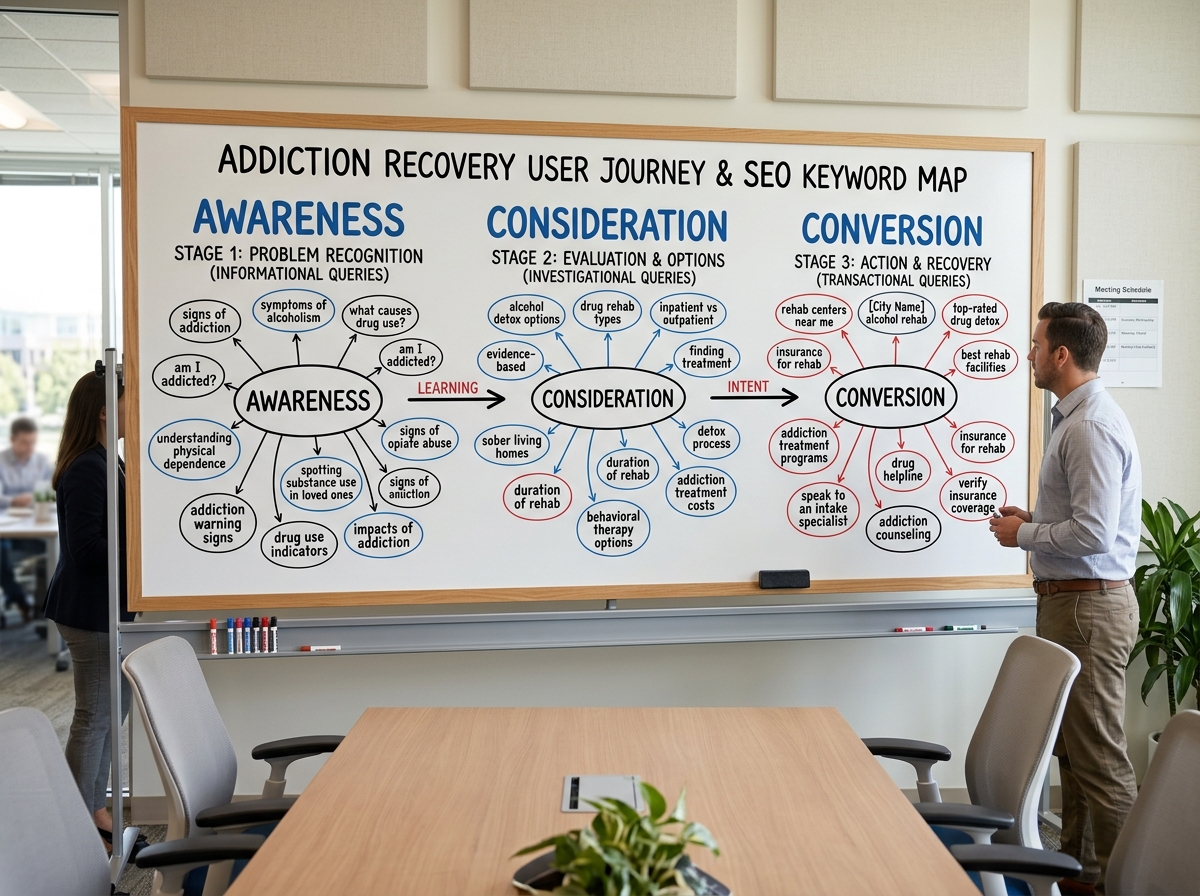
Targeting High-Intent Keywords for Your Addiction Recovery SEO Strategy
To fill your beds, we focus on transactional terms. These are keywords that indicate someone is ready to take action. Effective targeting includes:
- Geo-modifiers: People want help close to home. Keywords like “rehab center in California” or “detox near me” are essential.
- Substance-specific queries: Someone looking for “fentanyl withdrawal support” has a very different need than someone searching for “alcohol moderation.”
- Insurance-based searches: This is a big one. Research shows that 86% of searchers check insurance acceptance before making a call. Phrases like “rehabs that accept Aetna” or “Cigna-approved detox centers” are gold mines for admissions.
How Competitor Analysis Refines Your Keyword Selection
We don’t work in a vacuum. By using tools like SEMrush or Ahrefs, we can see exactly which keywords your competitors are ranking for. We look for “content gaps”—topics they’ve missed or explained poorly—and we create something better.
If a large national brand is dominating a broad term, we don’t try to outspend them. Instead, we out-think them by targeting niche SERP (Search Engine Results Page) features like the “People Also Ask” boxes or local map packs where smaller, specialized facilities can often win.
On-Page and Content Excellence: Building E-E-A-T
Google’s North Star for ranking medical content is Google’s E-E-A-T guidelines, which stands for Experience, Expertise, Authoritativeness, and Trustworthiness.
In a post-Helpful Content Update world, you cannot simply churn out generic, AI-generated blog posts. Your content must demonstrate clinical authority. This means having your articles reviewed or written by licensed clinicians (LCSWs, MDs, PsyDs) and citing reputable sources like PubMed.
Effective Search Engine Optimization (SEO) for rehab centers means creating content that is empathetic yet professional. We want to move the needle from “I’m interested” to “I trust this facility with my life.”
Structuring Content for an Effective Addiction Recovery SEO Strategy
A website with 500 random blog posts is confusing for both Google and your visitors. We use a “topical map” approach, which organizes your site into logical clusters.
- Pillar Pages: Comprehensive guides on broad topics (e.g., “The Ultimate Guide to Alcohol Recovery”).
- Cluster Content: Specific articles that link back to the pillar (e.g., “Signs of Alcohol Poisoning,” “What to Pack for Rehab”).
For a deeper dive into the “behind-the-scenes” mechanics, check out our Technical SEO for Treatment Centers: A Plain English Guide. Proper header hierarchy (H1, H2, H3) and descriptive meta tags aren’t just for bots; they help stressed-out family members navigate your site quickly to find the information they need.
The Role of Patient Reviews and Testimonials in SEO
Trust is the currency of the recovery industry. Patient testimonials are powerful “social proof.” When you implement review schema—a type of code that tells Google “this is a rating”—you can actually get those gold stars to show up in search results.
Reputation management is a core part of an addiction recovery seo strategy. Responding professionally to both positive and negative reviews on platforms like Google My Business signals to Google that you are an active, trustworthy business.
Dominating Local Search and Technical Foundations
Most people searching for treatment start with a local query. If you aren’t appearing in the “Map Pack” (the top three local listings on Google), you are missing out on the majority of your potential leads. This is the essence of Local SEO.
For operators with multiple facilities, the strategy becomes even more nuanced. You can learn more about this in our guide on Cracking Local SEO: A Guide for Multi-Facility Operators.
Optimizing Google Business Profiles and Directories
Your Google Business Profile (GBP) is often the first thing a potential patient sees. To optimize it:
- Claim your short name: This makes it easier for patients to find and review you.
- NAP Consistency: Your Name, Address, and Phone number must be identical across every directory, from Yelp to Healthgrades.
- Regular Posts: Use the GBP post feature to share facility photos, staff bios, and success stories.
Why Technical SEO is the Foundation of Your Strategy
You could have the best content in the world, but if your site takes 10 seconds to load, no one will ever see it. Technical SEO ensures that search engines can “crawl” and index your pages correctly.
Key technical factors we prioritize include:
- Site Speed: We aim for a load time of under two seconds. Tools like Optimizilla help us compress images to keep things moving fast.
- Mobile Responsiveness: Over 60% of healthcare searches happen on mobile devices. If your site doesn’t work perfectly on a smartphone, you’re losing patients.
- HTTPS Security: For a YMYL site, a secure connection is non-negotiable for building user trust and satisfying Google’s security requirements.
Frequently Asked Questions about Rehab SEO
How long does it typically take to see results from rehab SEO campaigns?
SEO is a marathon, not a sprint. While every facility is different, most rehab centers begin to see noticeable improvements in organic impressions and rankings within 3 to 6 months. For highly competitive national keywords, it may take 9 to 12 months to reach the top spots. However, Local SEO often yields “quick wins” much faster, sometimes within the first 60 to 90 days.
Is SEO more cost-effective than PPC for addiction treatment marketing?
In the long run, absolutely. While PPC provides an immediate “faucet” of leads, those leads stop the second you stop paying. SEO is an investment in an asset you own. When you look at the SEO vs PPC for Drug Rehabs comparison, the cost-per-acquisition (CPA) for organic leads is usually significantly lower over a 12-month period compared to paid ads.
What are the biggest SEO mistakes rehab centers should avoid?
We see the same Mistakes Small Business Owners Make When Using SEO repeated constantly. The “Big Three” are:
- Keyword Stuffing: Writing for bots instead of humans. It makes you look untrustworthy and gets you penalized by Google.
- Duplicate Content: Copying treatment descriptions from other sites. Google rewards originality.
- Ignoring Mobile Users: Having a site that looks great on a desktop but is impossible to use on a phone.
Conclusion: Let’s Build Your Admissions Pipeline
Building an addiction recovery seo strategy isn’t just about “ranking #1.” It’s about being the lighthouse in the storm for someone who is lost. It’s about ensuring that when a person reaches their breaking point and types “I need help” into a search bar, your facility is the one that appears with the answers, the empathy, and the authority they need.
At Faebl Studios, we specialize in growth acceleration for the substance use treatment industry. We don’t just “do SEO”—we build sustainable admissions pipelines that help your facility grow so you can focus on what you do best: saving lives.
Are you ready to see where your current strategy is leaking leads? We offer a comprehensive free audit to identify growth opportunities and provide a roadmap for your facility’s success.
Get Your Free Growth Audit and SEO Analysis
Let’s turn your website into your most powerful tool for recovery. Contact us today to start your journey toward sustainable, ethical growth.