


Why Rehab SEO Keyword Research Decides Who Fills Your Beds
Rehab SEO keyword research is the process of identifying the exact search terms people use when looking for addiction treatment — and then building your website around those terms to drive qualified admissions.
Here’s a quick breakdown of what it involves:
| Step | What It Means |
|---|---|
| Find the right keywords | Identify high-intent terms like “drug rehab near me” or “does Blue Cross cover residential treatment” |
| Understand search intent | Match keywords to where someone is in their decision journey (awareness → action) |
| Prioritize by value | Weigh search volume, ranking difficulty, and conversion potential |
| Target locally | Focus on geo-specific terms like “[city] alcohol treatment” |
| Map to content | Assign keywords to service pages, blog posts, and location pages |
Over 93% of online experiences start with a search engine. When someone is ready to get help — for themselves or a loved one — they go to Google first. If your facility doesn’t show up, a competitor’s does.
The stakes are high. A missed search is a missed admission.
I’m Michael Krowne, CEO and Co-Founder of Faebl Studios, and I’ve spent 20+ years helping treatment centers master rehab SEO keyword research to generate over 10,000 admissions nationwide. In this guide, I’ll walk you through exactly how to do it right — from keyword fundamentals to advanced strategies that turn organic traffic into verified benefits and real admissions.
The Fundamentals of Rehab SEO Keyword Research
When we dive into rehab SEO keyword research, we aren’t just looking for words; we’re looking for a lifeline. In the addiction treatment space, keywords are the bridge between a person in crisis and the clinical care they desperately need. But not all keywords are created equal. If you try to rank for everything, you’ll likely end up ranking for nothing.
To build a solid foundation, we need to understand the three main pillars of keyword types: short-tail, long-tail, and local.
Short-Tail vs. Long-Tail Keywords
Short-tail keywords are broad, one-to-two-word phrases like “rehab” or “addiction treatment.” These get massive search volume but are incredibly difficult to rank for because every facility in the country is fighting for them.
Long-tail keywords, on the other hand, are longer, more specific phrases. Think “inpatient drug rehab for young adults in California” or “holistic alcohol detox programs.” While these have lower search volumes, the people searching for them are much closer to making a decision.
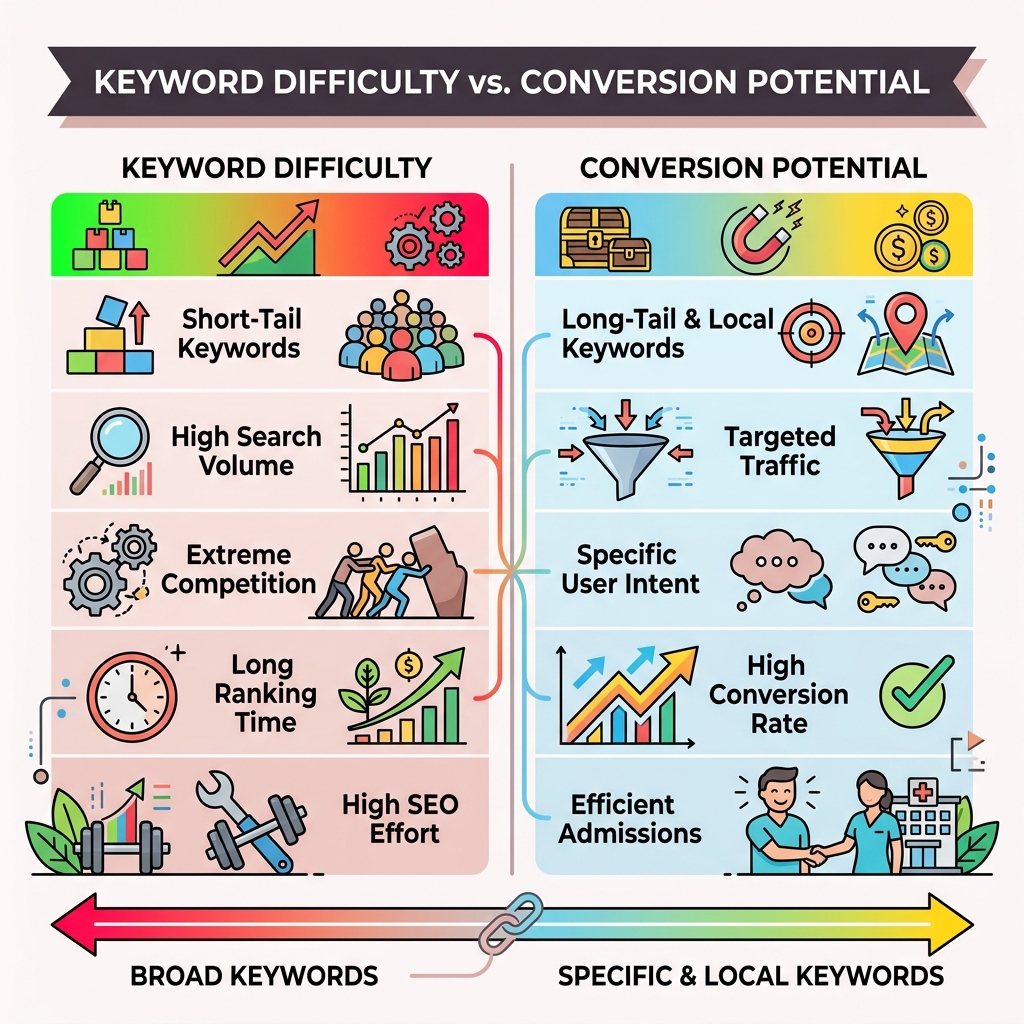
| Keyword Type | Example | Search Volume | Competition | Conversion Rate |
|---|---|---|---|---|
| Short-Tail | “Drug Rehab” | Very High | Extreme | Low |
| Long-Tail | “Dual diagnosis treatment for veterans” | Moderate | Low/Medium | High |
| Local | “Drug rehab Los Angeles” | High | High | Very High |
The Reality of Search Volume and Difficulty
Data tells us that “addiction treatment center” receives about 79,200 yearly searches, while “alcohol addiction treatment” hits 43,200. These are “Very Hard” to rank for. If you’re a newer facility or a smaller center in a competitive market like Los Angeles, chasing these broad terms exclusively is a recipe for frustration.
Instead, we focus on finding the “sweet spot”—keywords with enough volume to matter, but specific enough that we can actually win the top spot on Google. Understanding Why SEO is Crucial for Drug Rehab Centers helps us realize that SEO isn’t just about traffic; it’s about building authority so that search engines trust us enough to show us to people in need.
Local SEO: The “Near Me” Battle
For most treatment centers, your bread and butter will be local searches. Most families prefer a facility within driving distance, or at least within their state. Keywords like “addiction treatment center near me” (10,560 yearly searches) are high-intent goldmines. When we optimize for these, we aren’t just looking at the website; we’re looking at your Google Business Profile and local citations.
Mapping Search Intent to the Recovery Journey
One of the biggest mistakes we see treatment centers make is treating every visitor the same. In reality, a person’s search query tells us exactly where they are in the “Recovery Journey.” If we don’t map our rehab SEO keyword research to this intent, we end up providing a “Buy Now” solution to someone who is still asking “Do I have a problem?”
1. Informational Intent (The Awareness Phase)
Searchers here are looking for answers. They might search for:
- “Signs of opioid addiction”
- “How long does alcohol detox last?”
- “Can you go to rehab without insurance?”
At this stage, they aren’t ready to admit. They need education. We target these with blog posts and resource guides. By answering these questions, we build trust. When they are ready to take the next step, they’ll remember who gave them the best information. You can learn more about this in our guide on How Do People Search for Drug Rehab Centers?.
2. Commercial Investigation (The Consideration Phase)
Now, the searcher knows they need help and is comparing options. Keywords include:
- “Best residential treatment centers in California”
- “Luxury rehab vs. standard rehab”
- “Top-rated dual diagnosis programs”
They are looking for “the best” and checking reviews. This is where your service pages and “Why Us” content need to shine.
3. Transactional Intent (The Crisis/Action Phase)
This is the “bottom of the funnel.” These searchers have their insurance card in hand and are ready to call.
- “Aetna approved drug rehab Los Angeles”
- “Immediate openings for detox”
- “Speak to an addiction counselor now”
These keywords have the highest conversion rates. We call these “high-intent modifiers.”
High-Intent Keyword Modifiers to Target:
- “…near me”
- “…that accept [Insurance Provider]”
- “Inpatient…”
- “Emergency…”
- “Affordable…”
- “Top-rated…”
Advanced Strategies and Tools for High-Conversion Rankings
Once you have your basic list, it’s time to get sophisticated. Google’s algorithms are smarter than ever, especially after the Helpful Content Update. They no longer just look for keywords; they look for “Topical Authority.”
This means Google wants to see that you are an expert on the entire subject of addiction, not just someone trying to rank for a specific term. We achieve this by building “Pillar Pages”—massive, 2,000+ word guides on a core topic (like “Alcoholism”)—and then linking to smaller, supporting articles (like “The Dangers of DTs” or “Alcoholism in the Workplace”).
The Role of Technical SEO
You can have the best keywords in the world, but if your site takes 10 seconds to load on a mobile phone, that person in crisis will click the “Back” button. Technical health is a prerequisite for ranking. We always recommend a Technical SEO for Treatment Centers: A Plain English Guide to ensure your site’s “engine” is running smoothly.
Mastering Long-Tail Rehab SEO Keyword Research for Specific Programs
To really dominate, we need to niche down. General “rehab” keywords are a bloodbath. But specific programs? That’s where the opportunity lies.
- Opioid Treatment: Focus on “Medication-Assisted Treatment (MAT) in [City]” or “Suboxone clinic near me.”
- Alcohol Detox: Target “medical detox for alcohol withdrawal” or “safe alcohol detox programs.”
- Specialized Populations: Keywords like “rehab for first responders,” “LGBTQ+ friendly addiction treatment,” or “teen drug rehab California” allow you to speak directly to a specific audience.
When you target these specific niches, your conversion rate skyrockets because the searcher feels like you built your program just for them. For more on how to win these local battles, check out our More info about local SEO services.
Conducting Competitor Gap Analysis for Rehab SEO Keyword Research
Why reinvent the wheel? Your competitors have already done a lot of the work for you. By using tools like SEMrush or Ahrefs, we can perform a “Keyword Gap Analysis.”
This process identifies which keywords your competitors are ranking for that you aren’t.
- Identify Top 3 Competitors: Look at who is consistently in the top spots for your primary terms.
- Run the Gap Report: Find the “Common” keywords where they beat you, and the “Missing” keywords where they rank but you don’t even have a page.
- Analyze Content Quality: Don’t just copy them—make something better. If their page is 1,000 words, make yours 2,000 with better graphics and clearer CTAs.
This is especially vital for multi-location facilities. If you’re managing several centers, you need a strategy for Cracking Local SEO: A Guide for Multi-Facility Operators to ensure your locations aren’t competing against each other for the same keywords.
Frequently Asked Questions about Addiction Treatment SEO
Navigating rehab SEO keyword research can be overwhelming. Here are the most common questions we hear from facility owners and marketing directors.
How long does it take to rank for rehab keywords?
SEO is a marathon, not a sprint. Generally, you can expect to see movement in 3 to 6 months. For highly competitive “national” keywords, it may take 12 months or more of consistent content and backlink building. However, local SEO (like ranking in the Map Pack for your city) can often show results much faster if your profile is optimized correctly. It’s often a debate of SEO vs PPC for Drug Rehabs—PPC gives you instant traffic, but SEO builds a long-term asset that lowers your cost-per-acquisition over time.
What are the most difficult keywords to rank for?
The “big” ones. “Drug rehab,” “rehab center,” and “addiction treatment” are the hardest. Also, any keyword involving a major insurance provider (e.g., “Blue Cross Blue Shield rehab”) is highly competitive because those leads are incredibly valuable to admissions teams.
How has AI impacted rehab keyword strategy?
AI Overviews (formerly SGE) are changing how people get information. Instead of clicking a link, Google might answer the question directly. To stay relevant, your rehab SEO keyword research must focus on “Entity-based SEO”—ensuring Google recognizes your facility as a real, authoritative entity with staff credentials, certifications (like Joint Commission or CARF), and real patient reviews. AI favors websites that demonstrate E-E-A-T (Experience, Expertise, Authoritativeness, and Trustworthiness).
Conclusion: Turning Keywords into Admissions
At the end of the day, rehab SEO keyword research isn’t about “gaming the system.” It’s about making sure that when a mother is sitting at her kitchen table at 2:00 AM, crying because she doesn’t know how to help her son, your facility is the one that shows up with the answers.
We see too many facilities “relapse” on their rankings because they stop producing content or ignore consistent algorithm updates. Don’t let that be you.
At Faebl Studios, we specialize in growth acceleration for the substance use treatment industry. We don’t care about vanity metrics like “impressions” or “clicks.” We care about the “North Star” metric: Admissions. We help you track every keyword from the first search all the way to the intake call.
If you’re ready to see where your facility is leaving money (and lives) on the table, we want to help. We offer a Get a free SEO analysis for your facility to identify the exact keyword gaps and technical hurdles holding you back.
Let’s build a patient acquisition engine that works as hard as your clinical team does. Reach out to us today, and let’s start filling those beds with the people who need you most.