


Why Most Rehab Ads Are Just Expensive Noise
Rehab paid media experts are specialized digital marketing professionals who run paid advertising campaigns exclusively for addiction treatment centers. They navigate the industry’s strict platform rules, high keyword costs, and unique admissions dynamics that general agencies routinely miss.
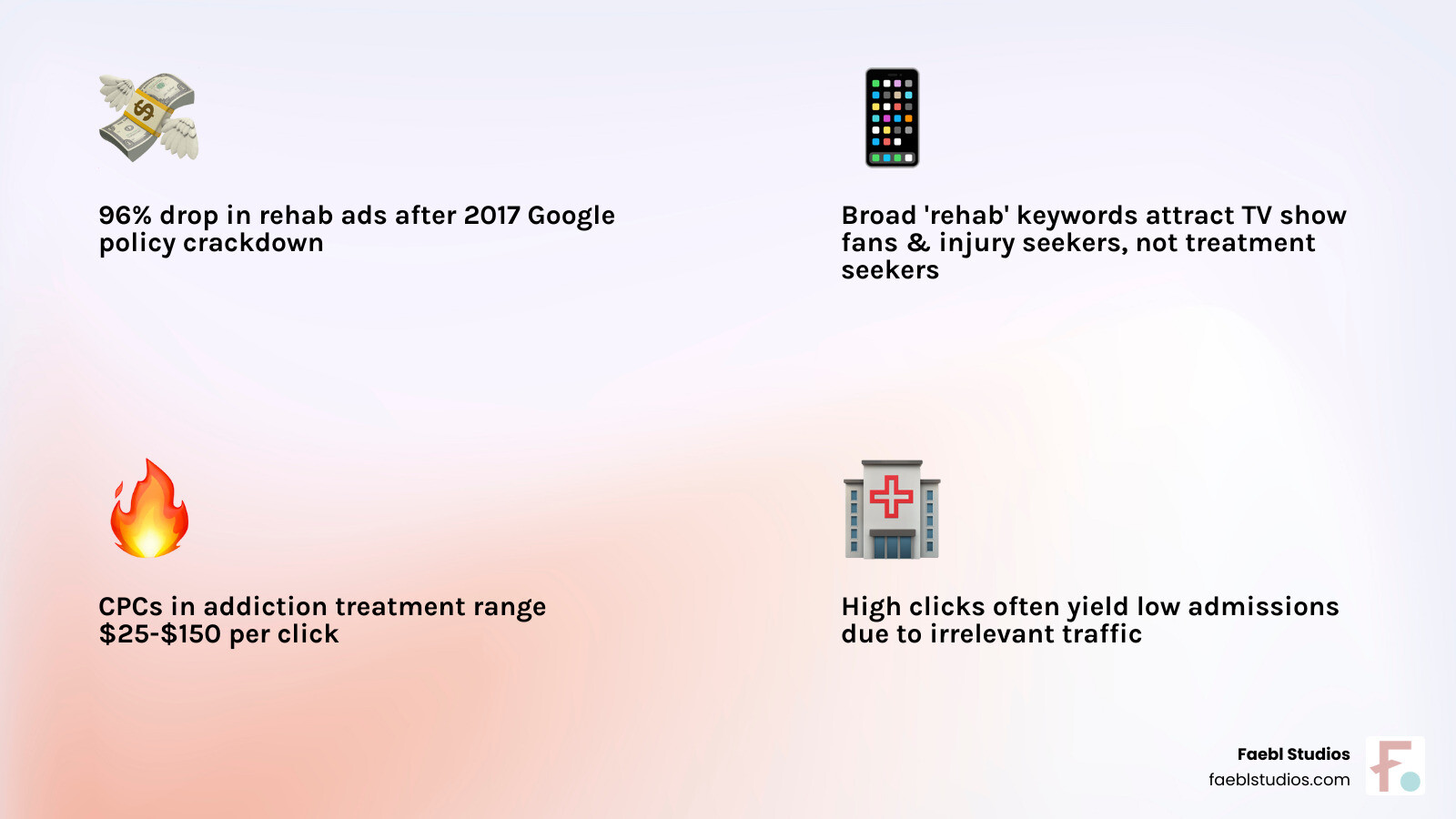
Before you hire one, there are a few non-negotiables. You need LegitScript certification just to get through the door on Google, Meta, and Bing. Without it, your ads won’t even see the light of day. You also have to realize that clicks in this space are expensive, often ranging from $25 to $150. A few wrong moves with broad keywords like “rehab” can drain a budget on traffic for TV shows or sports injuries rather than people seeking help. A real expert focuses on admissions, not just clicks, and understands the nuances of ASAM levels and HIPAA compliance that generalists ignore.
When Google cracked down on addiction treatment advertising in 2017, the number of rehab ads running on the platform dropped by roughly 96% after the “wild west” era of the opioid epidemic. That single policy change wiped out most of the industry’s paid media overnight, and the centers that survived were the ones working with people who actually understood the space.
That’s the world rehab paid media experts operate in. High stakes, high costs, and almost no margin for error, because the people clicking those ads aren’t shopping for furniture. They’re in crisis. Or their family is.
I’m Michael Krowne, CEO and Co-Founder of Faebl Studios, and over the past two decades I’ve helped generate more than 10,000 treatment admissions and over $300 million in billing value for rehab facilities across the country, making me one of the more hands-on rehab paid media experts you’ll find writing about this topic. What follows is a clear-eyed look at who’s doing this work well, how they do it, and what it actually costs when you get it wrong.
If you have ever sat in your office staring at a spreadsheet, wondering why you spent twenty thousand dollars on Google Ads last month but only got two admissions, you are not alone. It is a nauseating feeling. You see the clicks. You see the “traffic” rising. But the phones aren’t ringing with families in need; they are ringing with people looking for the TV show “Rehab Addict” or someone trying to fix a torn ACL.
The disconnect happens because generalist agencies treat the word “rehab” like any other keyword. They don’t realize that in our world, a broad match keyword is a vacuum for wasted cash. When you bid on generic terms, you are competing with celebrity gossip sites and physical therapy clinics. You are essentially setting piles of money on fire to attract people who will never walk through your doors.
The High Stakes of Hiring Rehab Paid Media Experts

In most industries, a “bad” ad campaign means a slightly lower profit margin for the quarter. In behavioral health, the stakes are fundamentally different. Every click that is wasted on an irrelevant search is a missed opportunity to help someone in a life-or-death situation. We aren’t just managing budgets; we are managing the digital bridge between a person in crisis and the help they desperately need.
The financial barrier to entry is also staggering. PPC for Rehab and Treatment Centers is one of the most expensive verticals in the world. When clicks cost between $25 and $150 each, you can blow through a monthly budget in a single afternoon if your targeting is off. True rehab paid media experts understand that these aren’t just data points on a screen—they are human beings. This perspective changes how we write copy and how we bid. We focus on maximizing recovery success by humanizing the leads. We want the person on the other end of the screen to feel seen and understood, not like they are being funneled into a sales machine.
A generalist agency might be great at selling shoes or software, but they rarely understand the nuances of the American Society of Addiction Medicine (ASAM) levels of care. They don’t know the difference between a client looking for a medically monitored detox and someone who needs a low-intensity outpatient program. If your ads are promising “inpatient” care but your facility only offers IOP, you are paying for clicks that can never convert. Industry-specific experts also understand the payer mix. We know how to tailor campaigns based on whether a facility accepts private insurance, out-of-network benefits, or state-funded programs. Following paid ads for drug rehab centers: best practices means aligning your ad spend with your actual admissions capacity. Generalists often ignore the admissions cycle entirely, failing to realize that a lead generated at 2:00 AM on a Tuesday requires a different follow-up strategy than one that comes in during business hours.
The bidding wars in the addiction treatment space are legendary. With some agencies managing over $100M in ad spend, the competition for the top spot on Google is fierce. It is very easy to fall into the trap of thinking that more money equals more admissions. Often, the opposite is true. You might actually be spending too much on Google Ads because your Quality Score is low or your landing pages aren’t converting. Efficiency is the name of the game. We have seen campaigns where consolidating ad groups and refining match types reduced the cost per admission significantly while actually increasing the number of beds filled. It isn’t about who has the biggest wallet; it’s about who has the smartest strategy in a hyper-competitive market like California or Los Angeles.
Navigating the LegitScript Minefield and Platform Rules
If you tried to run an ad for a rehab center today without LegitScript certification, Google would shut you down before your first cup of coffee was cold. This certification isn’t just a “nice to have”. It is the gatekeeper of the entire industry. Ever since the 2017 crackdown, which saw a 96% reduction in rehab ads, the platforms have been incredibly wary. Google tightened those rules after years of abuse in addiction treatment advertising, when lead sellers and bad actors made it harder for legitimate centers to be trusted online. If you want the broader background on how the platform itself works, Google Ads is a useful reference point.
LegitScript involves a rigorous verification process. They look at your staff’s credentials, your facility’s licensing, and your history of legal adherence. They want to ensure that when someone clicks an ad, they are being directed to a legitimate, safe program. The rules are constantly shifting, too. For example, the Google Ads policy update November 2025 introduces even stricter rules for healthcare clinics.
It isn’t just Google, either. Meta has its own set of hurdles. Staying compliant requires a deep understanding of the Meta ad 2025-2026 restrictions, which affect how behavioral health providers can target and speak to their audience on Facebook and Instagram. An expert partner knows how to navigate these minefields so your account doesn’t get flagged or permanently banned.
Strategies That Actually Fill Beds Without Wasting Budget
The secret to a successful campaign isn’t bidding on the most popular keywords. It is bidding on the right ones. While “drug rehab” might have a massive search volume, it is often too broad to be useful. Instead, we focus on long-tail keywords—specific phrases that indicate a high intent to actually start treatment. Think about the difference between someone searching for “alcohol” and someone searching for “best inpatient rehab center for alcoholism in Los Angeles.” The second person is much closer to making a decision. We also lean heavily into “near me” searches, as many clients and their families prefer facilities that are geographically accessible. Negative keywords are equally important. We spend a lot of time telling Google what we don’t want. If your facility doesn’t offer free services, you should not be showing up for “free rehab” or “Medicaid-funded detox.” By excluding these terms, you stop the “budget bleed.” We have seen cases where simply tightening these filters cut the cost per admission in half for a Midwestern IOP.
Once the right person clicks the ad, the work is only half done. The landing page they land on has to be fast, mobile-optimized, and deeply relevant to their search. If they clicked an ad for “heroin detox,” they shouldn’t land on a generic homepage talking about your facility’s mountain views. They need to see information about detox immediately. We use A/B testing to constantly refine everything from the headline to the color of the “Call Now” button. This is the core of conversion rate optimization. Small tweaks can have a massive impact on your Quality Score, which in turn lowers your cost per click. We also make heavy use of call extensions and location extensions. When a family is in crisis, they don’t want to hunt for a phone number. They want a button they can tap to speak to a human being right now. Paid media doesn’t exist in a vacuum. It works best when it is part of a coordinated digital strategy. There is a constant debate about SEO vs PPC for drug rehabs, but the truth is you usually need both. PPC gives you the speed and precision to fill beds today, while SEO builds the long-term authority that lowers your overall acquisition costs over time. In the Google Ads vs Google SEO battle, PPC can actually boost your brand awareness by as much as 80%. Even if someone doesn’t click your ad today, seeing your name at the top of the search results builds trust. When they see your facility appear again in the organic results or on social media, that familiarity often becomes the deciding factor in choosing your program.
Measuring What Matters: Beyond Clicks to Admissions
Most agencies will send you a report full of vanity metrics. They will brag about how many thousands of impressions you got or how high your click-through rate is. But you can’t pay your staff with impressions.
| Metric | Why It Matters | Why It Can Be Deceptive |
|---|---|---|
| Impressions | Shows brand reach. | Doesn’t mean anyone actually looked at the ad. |
| Clicks | Shows interest. | Could be irrelevant traffic (e.g., “Rehab Addict” fans). |
| Cost Per Lead (CPL) | Shows efficiency of lead gen. | A “lead” might just be someone looking for a job. |
| Cost Per Admission (CPA) | The holy grail. Shows actual ROI. | Requires deep CRM integration to track accurately. |
True rehab paid media experts measure success in admissions. We look at the entire funnel, from the first click through the Verification of Benefits (VOB) to the moment the client checks in. We have seen specialized strategies lead to a 604% increase in admissions while lowering the cost per admission by 86% in just 90 days. We have also seen call volumes jump by 242% and qualified calls—the ones that actually have the right insurance and clinical fit—grow by 625%. To get these results, we perform a deep Google Ads teardown to see where the system is breaking. We integrate with your CRM and admissions team so we can see exactly which keywords are producing the most admits, not just the most phone calls.
Frequently Asked Questions about Rehab Advertising
How much does a click cost in the addiction treatment space?
It is one of the most expensive industries on the internet. Depending on the location and the specific keyword, you can expect to pay anywhere from $25 to $150 per click. This is why having a tight, optimized strategy is non-negotiable.
What is the difference between a lead and a qualified admission?
A lead is just a phone call or a form fill. It could be someone looking for a job, a person with the wrong insurance, or someone looking for a type of treatment you don’t offer. A qualified admission is a person who fits your clinical criteria, has the right insurance or payment method, and actually begins treatment at your facility.
Why do I need LegitScript if I am already licensed by the state?
Google and Meta are not government agencies; they are private platforms with their own global standards. They use LegitScript as a third-party “seal of approval” to simplify their own compliance checks. State licensing is a legal requirement to operate, but LegitScript is the digital requirement to advertise.
Choosing a Partner Who Understands the Mission
At the end of the day, your marketing partner should be an extension of your admissions team. They should understand that your goal isn’t just to “get traffic”—it is to fill beds and save lives. At Faebl Studios, we specialize in growth acceleration for the substance use treatment industry. We don’t just look at dashboards; we look at the people behind the numbers. Our unique selling proposition is simple: we provide a free audit to identify exactly where your current strategy is failing. We look for the “budget bleed,” the broad keyword traps, and the landing page friction that is keeping you from reaching your full census. Whether you are in Los Angeles or anywhere else in California, we focus on Pay Per Click (PPC) management that produces predictable results. Don’t let a generalist agency treat your life-saving mission like a generic commodity. Work with people who speak the language of behavioral health and understand the weight of the work you do. Let’s stop burning cash and start filling beds with the people who need your help the most.