



Why Drug Rehab Marketing Is a Life-or-Death Skill for Treatment Centers
Drug rehab marketing is how addiction treatment centers reach people who need help, build trust with them and their families, and guide them toward making the call that could change their lives.
Here’s a quick breakdown of what it actually involves:
| Core Area | What It Means |
|---|---|
| Visibility | Showing up on Google when someone searches for help |
| Trust-building | Creating content and a reputation that earns confidence |
| Lead generation | Turning searches and clicks into real phone calls |
| Conversion | Getting those calls to become actual admissions |
| Compliance | Following rules like LegitScript, HIPAA, and FTC guidelines |
Think about who is actually doing these searches. In the middle of the night, a husband, sister, or parent is sitting with a phone in hand, typing in a desperate search and hoping the next click leads somewhere real. Industry reporting has long shown that most people looking for addiction treatment, or the family members helping them, begin online. In practice, Google is often the first doorway. If your center shows up, you have a chance to help. If it does not, that moment goes to someone else.
There are roughly 18,000 treatment centers in the U.S. competing for that moment.
That is the reality of drug rehab marketing in 2026. It is not about clever slogans or trying to sound cooler than the rehab down the street. It is about being easy to find, easy to trust, and clear about what happens next. It also means following the rules that protect vulnerable people, including standards tied to HIPAA, the FTC, and LegitScript.
Over the years, working in marketing and operations for addiction treatment centers has made one thing obvious: the centers that grow are usually the ones that remove friction at every stage. They show up in search, answer the right questions, pick up the phone, and make the next step feel possible. In this guide, I will walk through the parts that actually move admissions, from SEO and paid ads to ethics, call handling, and ROI.
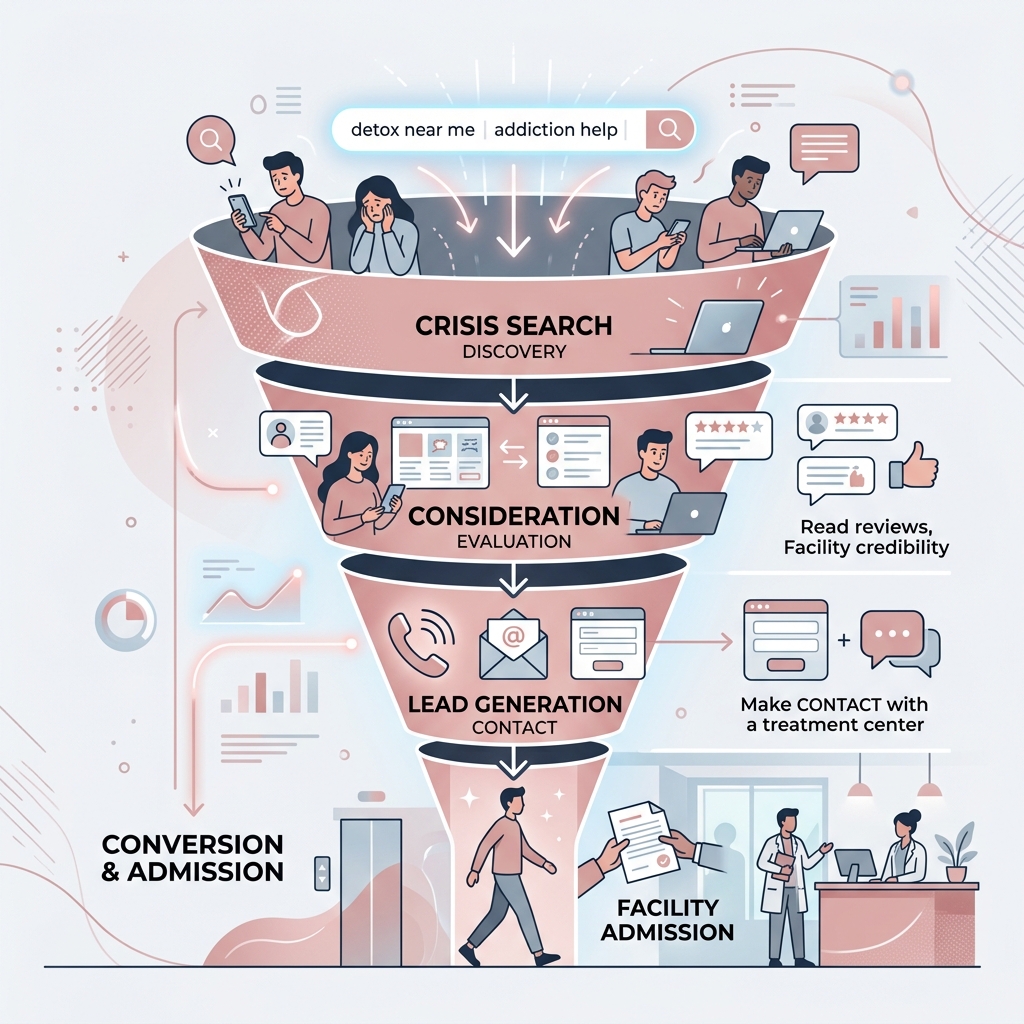
Why Being Seen Online Can Literally Save Lives

Imagine someone sitting alone in a parked car or a quiet living room at 2 AM. They are scrolling through their phone, eyes stinging from exhaustion and tears, typing “detox near me” into a search bar. This isn’t just a data point in a marketing report; it is a moment of profound crisis. In our industry, being visible in that specific moment is the difference between someone finding a path to recovery or continuing a downward spiral.
When we look at the numbers, the weight of this responsibility becomes clear. With 61% of seekers starting on Google, your digital presence is the front door to your facility. If you aren’t on page one, you basically don’t exist to the person in that car. In the U.S. alone, there are over 13,000 to 18,000 addiction treatment centers. The competition is staggering, but the stakes are even higher.
The journey from that desperate 2 AM search to a client walking through your doors is a delicate one. It requires more than just a website; it requires a beacon of trust. We have seen how powerful this can be when done right. For instance, one psychiatric outpatient partner we worked with saw their daily organic search impressions jump from 1,632 to over 3,000 in less than two months. That is thousands of additional opportunities to connect with someone in need.
The Essential Ingredients for a Modern Rehab Marketing Strategy
To get noticed in a crowded market, you cannot lean on one tactic and hope for the best. If your whole admissions pipeline depends on Facebook and the platform changes the rules, you feel it fast. If you rely only on PPC, the phone can go quiet the second the budget stops. A strong strategy blends long-term organic growth with shorter-term paid traction.
That is why we focus on a multi-channel approach. SEO, paid ads, social media, and content should all tell the same story. We call that congruent messaging. If an ad talks about a veterans program but the landing page feels generic and vague, trust drops immediately. People notice that mismatch faster than marketers like to admit. You can explore some of the 10 Best Ways to Market Drug Rehab Centers to see how these pieces fit together. For most centers, the foundation is still Search Engine Optimization (SEO) Services.
Why SEO Isn’t Just a Buzzword, It’s Your Long-Term Growth Engine
SEO is the part of your marketing that keeps working after the monthly ad spend is gone. Paid ads can bring speed. SEO builds staying power. Across Google, organic listings still capture most clicks, which makes sense if you think about how people search. When someone is scared, skeptical, and trying to help a loved one, they tend to trust what looks earned more than what looks sponsored.
For a rehab, SEO means showing up for high-intent searches like “alcohol rehab Los Angeles” or “inpatient drug treatment.” It is also about proving your center is credible. Google talks about E-E-A-T, which stands for Experience, Expertise, Authoritativeness, and Trustworthiness. In plain English, they want to see that real qualified people are behind your content and that the information helps someone make a serious decision.
When SEO is done well, the results compound. We have seen centers go from barely visible to owning page-one real estate for terms that bring actual admissions. That kind of growth does not happen because a few keywords were stuffed into a page like it was 2009. It happens through technical cleanup, local optimization, content depth, and steady work over time. If you want a clearer picture, start with Why SEO is Crucial for Drug Rehab Centers and How Do People Search for Drug Rehab Centers?.
Paid Ads: Cutting Through the Noise (and the Red Tape)
PPC is the fast lane. If you have open beds now and need qualified calls this month, paid search can help. It can also get expensive in a hurry. In competitive markets, a single click on terms like “alcohol rehab near me” can cost well over a hundred dollars. If the landing page is weak or the calls are mishandled, that budget disappears fast.
This space is also heavily regulated, and that is a good thing. Treatment advertising has a messy history, which is exactly why platforms require added scrutiny. To run many addiction treatment ads on Google or Meta, centers generally need LegitScript certification. That review looks at licensing, operations, and whether the center is representing itself honestly. If you want the official background, LegitScript explains why these checks exist and how certification works.
Managing these campaigns also takes enough volume to learn from. Googles automation is useful, but it still needs conversion data. Without enough qualified calls coming in, the system is mostly guessing with your money, which is not a charming personality trait in an ad platform. For many programs, that means a monthly budget of at least $10,000, and often closer to $30,000 for a newer campaign. You can dig deeper in What is LegitScript and Why is it Necessary for Drug Rehab Marketing? or let us handle it through our Pay-Per-Click (PPC) Management Services.
Walking the Line: Ethics, Regulations, and Avoiding the Pitfalls
Marketing a rehab is not like marketing sneakers or meal kits or whatever else the internet is trying to sell this week. The people searching are vulnerable, scared, and often making decisions under pressure. That changes the standard. In addiction treatment, the old days of shady lead gen and patient brokering did real damage, which is why the rules are tighter now.
Ethical marketing starts with being honest. Do not claim you are the “best” or the “top-rated” rehab unless you can actually prove it in a way that would survive daylight. Do not hide whether you are in-network or out-of-network until the end of a long call. Do not imply a level of medical care you do not provide. These sound obvious, yet the industry has a long history of people acting as if common sense were an optional add-on.
The regulatory side matters too. Privacy requirements under HIPAA, truth-in-advertising expectations from the FTC, and laws aimed at reducing kickbacks and brokering all shape what responsible outreach looks like. The Federal Trade Commission has repeatedly warned treatment marketers about deceptive advertising for a reason. Families are making high-stakes choices, and misleading them is not just unethical. It can cause real harm.
We often point people to the film “Body Brokers” as a cautionary tale because it captured something ugly but familiar. When profit gets too far ahead of ethics, trust collapses. You can read our take here: Body Brokers Film Review: Ethics in Marketing for the Rehab Industry. In this field, reputation is earned slowly and lost quickly. Usually for very stupid reasons.
From a Click to a Client: Optimizing Your Internal Process
You can have the best drug rehab marketing in the world, but if your internal processes are broken, you’re just wasting money. Think of your marketing as the fuel and your facility as the engine. If the engine has a leak, it doesn’t matter how much gas you pour into it.
The first “leak” usually happens on the website. If a mother is looking for help for her son and your site takes six seconds to load on her phone, she’s gone. If she can’t find a “Click to Call” button within three seconds, she’s moving to the next center on the list. User experience (UX) is a clinical tool in this context. It needs to be empathetic and effortless. You can see our breakdown of this in What Makes a Good Rehab Website?.
The second, and often bigger, leak is the call center. The industry average call conversion rate for Google Ads is only 5%. That’s abysmal. A high-performing team should be aiming for a 1 in 3 conversion rate from qualified call to admission. We often see centers spend $50,000 a month on ads but $0 on training the people answering the phones. We’ve worked with facilities to fix these bottlenecks, like in this case where We Cut Cost Per Admission in Half for a Midwestern IOP.
Speaking Their Language: Building Trust with Authentic Messaging
When someone is in the middle of an overdose crisis or a family intervention, they don’t care about your Egyptian cotton sheets or your chef-prepared meals. They care about whether their loved one is going to survive. Too many rehabs market themselves like luxury resorts.
Your messaging needs to be “congruent.” If someone searches for “heroin detox,” your content should speak directly to the fear and physical pain of heroin withdrawal. It should offer a clear, medical solution. This is how you build a brand that people actually trust.
We’ve written extensively about why The Person Searching for Rehab at 2 AM Doesn’t Care About Your Amenities. Authentic communication is about meeting them where they are. It’s about creating How to Create Content That Converts by providing real answers to the terrifying questions they are asking their phone in the middle of the night.
Proving It Works: Measuring Your Marketing’s Real Impact
At the end of the month, the only metric that truly matters is: how many people did we help? In marketing terms, that means admissions. We don’t look at “vanity metrics” like likes or shares. We look at Cost Per Admission (CPA) and Return on Investment (ROI).
For an out-of-network (OON) campaign, it’s common to see a cost of $7,500 to $12,000 per admission. In-network providers can often get that under $6,000 because they can say “yes” to more callers. To get these numbers, you need “closed-loop reporting.” This means your website analytics talk to your CRM (Customer Relationship Management) software. You need to know that the person who clicked an ad for “dual diagnosis” three weeks ago is the same person who just finished their intake paperwork.
While an initial investment of $30,000 to $50,000 for a PPC launch might feel like a lot, you have to look at the data. We’ve seen clients achieve a 23x ROI by finally dialing in their targeting and messaging. If you’re curious about how to track these numbers for your own facility, we have a guide on Maximizing ROI in Digital Marketing for Addiction Treatment Centers and a Case Study: 23x ROI that breaks down the math.
Your Burning Questions About Rehab Marketing, Answered
How much should a center spend on PPC?
The “lowest viable” budget for a serious program is usually around $10,000 per month. However, for a new program with no historical data, we typically recommend starting at $30,000. Why? Because you need to “buy” enough data for Google’s algorithms to learn who your ideal client is. If you spend too little, you’ll get a few clicks here and there, but you’ll never reach the statistical significance needed to optimize your campaigns for lower costs.
How long does it take to see SEO results?
SEO is a slow-burn strategy. You should expect a baseline of about three months for technical optimization and content building to start showing movement. Real, significant growth in organic admissions usually takes six to nine months. However, once that engine is running, it is much more cost-effective than paid ads. We’ve seen organic traffic make up 88% of a client’s total traffic after a year of consistent effort.
Is social media effective for finding clients?
Yes, but not in the way most people think. Facebook and Instagram are better for “top of funnel” awareness and reaching family members. While someone might not search for a rehab on Facebook, they might see a compassionate post about recovery that resonates with them while they are worried about a sibling. It’s also a great place for alumni groups and aftercare support, which builds your facility’s long-term reputation.
Ready to Grow? Finding the Right Marketing Partner
Navigating drug rehab marketing is complex. You’re balancing clinical ethics, strict legal regulations, and a hyper-competitive digital landscape. Trying to do this with a generalist marketing agency that also handles HVAC companies and law firms is a recipe for disaster. They won’t understand the nuances of LegitScript, the sensitivity of the 2 AM searcher, or the complexities of insurance verification.
At Faebl Studios, we live and breathe this industry. We focus on growth acceleration because we know that when your facility grows, more people get the help they need. We don’t just look for clicks; we look for the admissions that keep your doors open and your beds full.
If you’re tired of guessing whether your marketing is working, we want to help. We offer a free audit to look under the hood of your current strategy and identify exactly where you’re losing potential clients. Whether you need to overhaul your Search Engine Optimization (SEO) Services or build a high-converting PPC campaign, we’re ready to partner with you. Let’s get to work on saving more lives.